












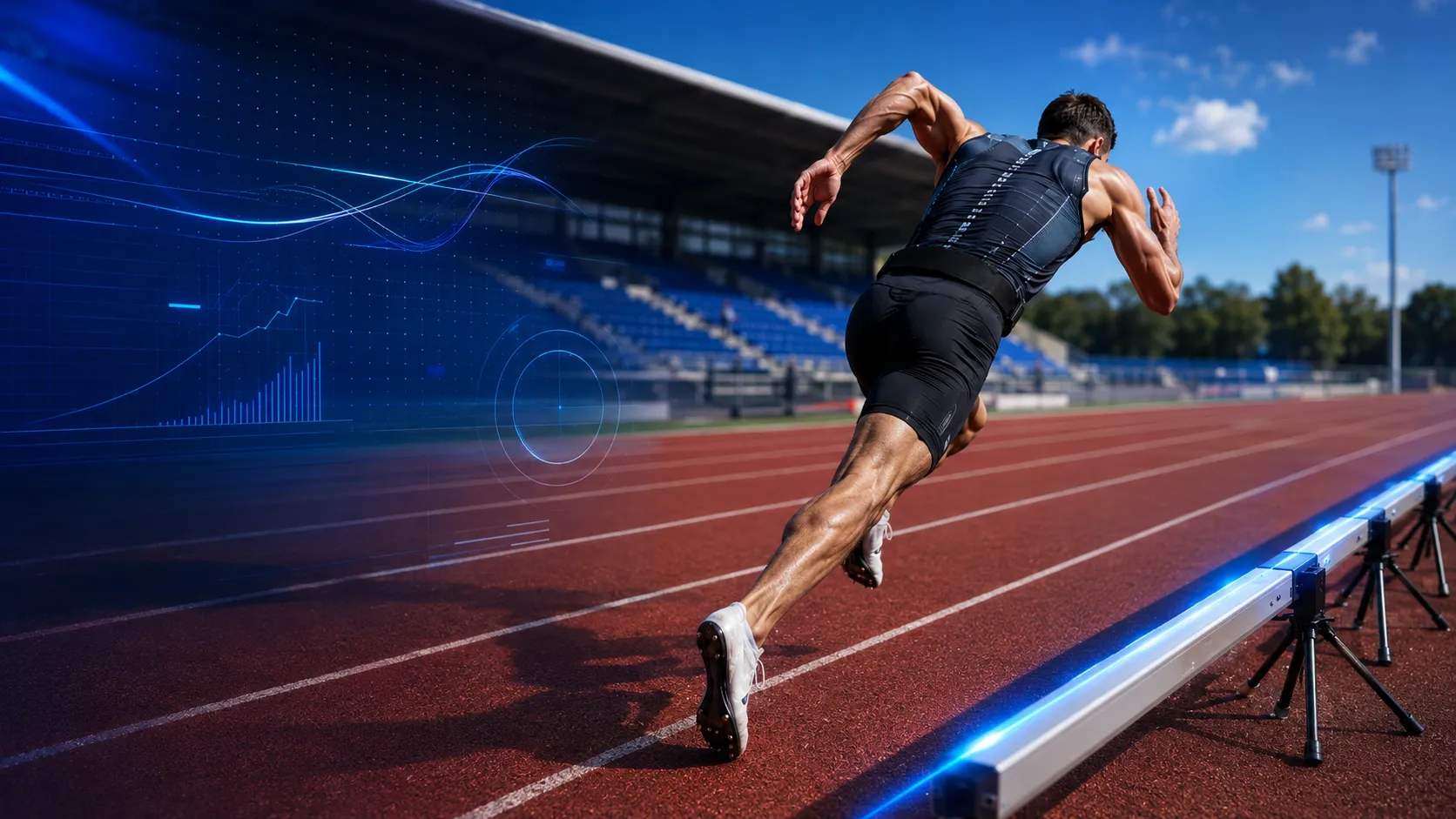
Measuring sprint performance is not only about recording a final time. To understand how an athlete runs, improves and produces speed, coaches also need to analyze stride parameters. Two key metrics are especially important: stride frequency, meaning the number of steps per second, and stride length.
A comparative study conducted in May 2025 by Colin Duilhe examined the validity of the Freelap system for measuring these stride parameters. The aim was to compare Freelap data with OptoJump, an optical system widely considered a reference for sprint stride analysis.
Why compare Freelap with OptoJump?
OptoJump is known for its precision. It analyzes ground contacts, step frequency and step length using optical cells placed along the track. This type of system is highly accurate, but it also comes with important limitations: high cost, complex setup, limited portability and significant installation time.
Freelap takes a different approach. With the Fx Motion chip and electromagnetic transmitters, the system collects data directly in field conditions, without complex installation or manual post-processing. Data is transmitted to the myFreelap app, making stride analysis more accessible for coaches.
A study with 47 athletes
The study included 47 athletes, ranging from recreational to elite level. Participants completed 20 m flying sprints, as well as 30 m block-start sprints for the more advanced sprinters.
In total, 149 valid trials were retained for analysis. The study compared stride frequency and stride length measured by Freelap and OptoJump during both the maximal velocity phase and the acceleration phase.
Strong results during maximal velocity
During the flying sprint trials, which represent the maximal velocity phase, Freelap showed excellent reliability. ICC values, a statistical indicator of measurement agreement, were equal to or greater than 0.97.
No significant bias was observed for stride frequency. For stride length, an average difference of around 1 cm was identified. This small difference should be interpreted carefully, as OptoJump is known to slightly overestimate some stride length measurements.
In practical terms, these results confirm that Freelap provides consistent and useful data for monitoring stride parameters during maximal velocity running.
Reliable results during acceleration
The acceleration phase is more difficult to analyze. Early steps change rapidly, stride mechanics evolve from step to step and the data are naturally more variable.
Despite this, Freelap maintained a high level of reliability. The study suggests harmonizing data processing between the two systems, especially by excluding the first two steps and the final step in some configurations. This approach is closer to the automatic processing used by Freelap in a Start-Finish setup.
This point is important: Freelap is not designed to replace a biomechanics laboratory. It provides reliable, fast and practical data for field-based training.
It is important to note that Freelap recommends a minimum distance of 20 meters between two transmitter cones. A distance of 10 meters is not sufficient to obtain a reliable and usable average speed. For a relevant performance analysis, it is recommended to maintain an interval of at least 20 meters.
It should also be noted that the FxMotion was developed primarily to meet the needs of the sprint market and high-speed running. To ensure the reliability of the data collected, the athlete must maintain a minimum speed of approximately 18 km/h. Below this threshold, the movement cadence becomes insufficient for the system to collect precise and representative performance data.
What this means for coaches
For coaches, the value of a measurement system does not depend only on absolute precision. It also depends on ease of use, setup time and the ability to collect comparable data from one session to the next.
This is where Freelap offers a strong advantage. The system allows coaches to monitor stride frequency and stride length in real training conditions, without disrupting the session. It helps them understand athlete progression, compare runs and support coaching decisions with objective data.
A balanced conclusion
The study concludes that Freelap is a reliable and relevant tool for training monitoring. Its portability, ease of use and measurement quality make it a credible alternative to OptoJump for field-based applications.
However, the study also makes an important distinction: the random error observed remains too high for Freelap to be considered a scientific gold standard at the same level as OptoJump.
The conclusion is therefore balanced and clear: Freelap is especially well suited for coaches looking for a reliable, practical and accessible tool to monitor stride parameters in everyday training.