

















Why timing is essential in skiing
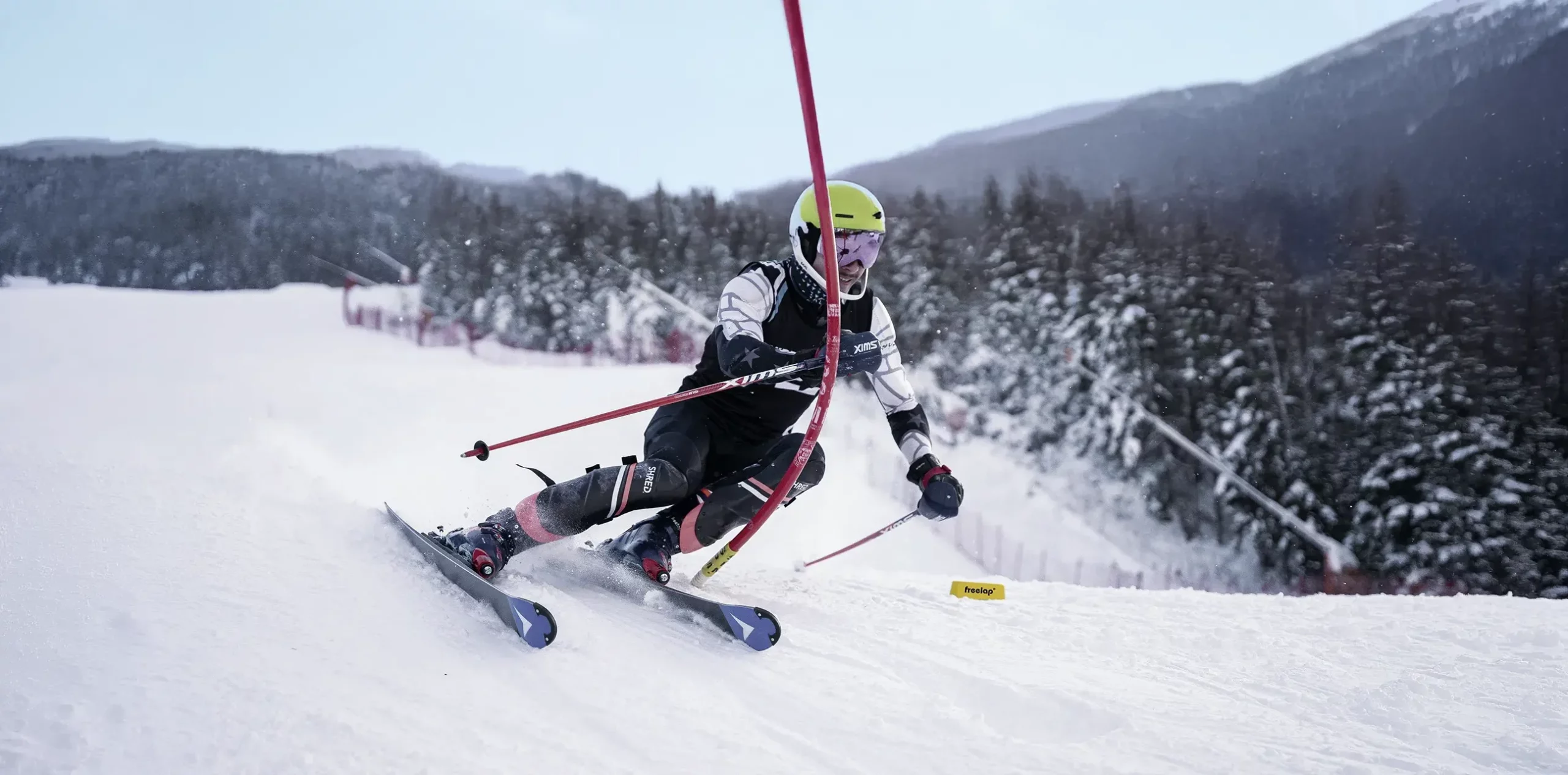
In alpine skiing, the gaps are tiny. A few hundredths of a second can make the difference between a successful run and a performance that needs to be corrected.
For coaches, timing is therefore not just a technical detail. It is a feedback tool. It helps determine whether one line is faster, whether an equipment change makes a difference, whether an athlete is truly progressing, or whether a feeling on the slope is not confirmed by the numbers.
But to be useful, a time must be reliable. Above all, it must be repeatable under the same conditions.
The challenge is that accurately measuring ski training times should not turn every session into a laboratory setup.
Photocells and laser timing gates : more accurate, but restrictive
Many clubs use laser systems or photocells to time training sessions.
On paper, this is a clear improvement over manual timing. Triggering is automated, human error is reduced, and times become more objective.
But in real conditions, on a slope, the limitations quickly become apparent :
- setup can take time
- the terrain is not always ideal
- snow, fog or wind can interfere with the beam
- a ski, pole or unintended movement can trigger the system too early
- the equipment can be difficult to move between two drills or two sections of the slope
These are good systems, but they often require a lot of attention. And when several young athletes are waiting in the cold, every minute spent setting up matters.
Photo finish : extremely precise, but rarely realistic for training
Official competitions, especially at the highest level, use certified photo-finish systems. These devices offer exceptional accuracy and help avoid any debate about the result.
For a race, this is ideal.
But for daily training, it is rarely realistic. These systems require a fixed installation, specialized staff and a significant budget. They are designed for competition day, not for a giant slalom session on a Tuesday morning.
The real challenge is therefore not only to look for maximum precision. It is to choose a system that can actually be used, day after day.
What coaches really need
In a training context, coaches do not necessarily need oversized technology. They need a system that works simply and consistently.
A good timing system should be :
- consistent, with the same measurement points on every run
- repeatable, to compare sessions and track progress
- practical, with quick setup and equipment adapted to mountain conditions
- reliable, even in the cold, snow or wind
- flexible, to measure a full run, a section or a specific drill
If the system meets these criteria, the data becomes useful. Otherwise, the times may create more confusion than value.
Why consistency matters more than absolute perfection
In training, the question is not always :
“Was this run 48.13 or 48.15 seconds ?”
The real question is rather :
“Is this athlete faster than last week ?”
“Is this new line better ?”
“Did this ski or waxing change have an impact ?”
To answer these questions, measurement consistency is essential. A theoretically perfect system that is difficult to reproduce from one session to another quickly loses its value.
What matters is being able to compare runs with confidence.
Same protocol.
Same zone.
Same measurement logic.
Same quality of feedback.
This stability is what allows coaches to make better decisions.
Where Freelap provides a real solution
Freelap addresses this exact need : providing reliable, portable timing adapted to real training conditions.
The system is wireless, easy to carry and quick to set up. Transmitters can be placed directly on the slope, and the athlete wears a chip that automatically measures the time.
The advantages are concrete :
- no cables
- no bulky tripods
- no laser beam to monitor
- quick setup
- usable in cold, snow and wind
- consistent times measured at skier level
- high flexibility to time sections, full runs or specific drills
Instead of spending time managing equipment, the coach can focus on what matters most : observing, correcting, comparing and helping athletes progress.
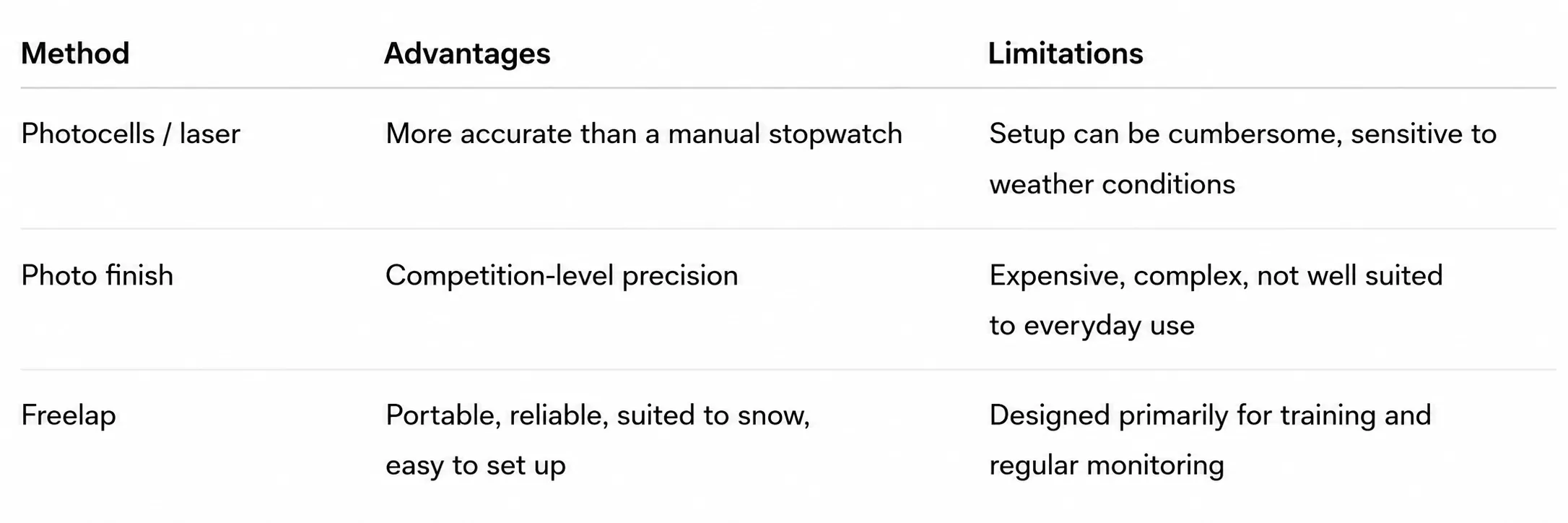
Comparison of timing solutions
Conclusion
So, how can you accurately measure ski training times ?
Photocells can be useful, but they can remain sensitive to conditions and unwanted triggers.
Photo finish is extremely precise, but not very realistic for daily use.
Freelap offers a balance that is better suited to training : portable, consistent, quick to set up and accurate enough to guide decisions in the field.
In skiing, the right timing system is not the one that makes the session more complicated.
It is the one that allows coaches to work better, faster and with reliable data.